The ABC of wristwatches explained simply and clearly
Watches have fascinated people for centuries, be it through their precise mechanics, their elegant design or their innovative technology. Wristwatches in particular are not only practical timepieces, but also an expression of style, status and personal taste. From mechanical masterpieces to classic quartz watches and digital models, there is a multitude of technologies, terms and functions that characterize the world of watches.
Our watch lexicon provides a comprehensive overview of the most important terms from the world of pilot’s watches from A to Z. What is the difference between automatic and mechanical movements, what are complications and how does the tourbillon actually work? Questions upon questions. We provide the answers. Immerse yourself in the fascinating world of timepieces and discover the impressive variety of individual components that go into every wristwatch.
The most important terms from A to Z
A B C D E F G H I J K L M N O P Q R S T U V W X Y Z
A
Analog display
The display of time using a set of hands on a dial. Usually there are three hands indicating the hours, minutes and seconds.
Annual calendar
A complication that automatically adjusts the date and month but, unlike the perpetual calendar, must be corrected manually in February.
Antimagnetic
Special materials used for the housing of a movement to make it resistant to damage caused by magnetic fields. The shielding of a watch from magnetic damage ensures the accuracy of a wristwatch.
Anti-reflective coating
A special coating on the watch glass that reduces reflections, making it easier to read. Often used on sapphire crystals.
Armature bridge
Holds the lever securely in position in the movement. Stabilizes the lever and ensures that it functions perfectly.
Assortment
The entirety of all parts of an escapement, consisting of anchor, escape wheel and balance. It forms the heart of every mechanical watch.
Automatic movement
A mechanical movement that uses the natural movements of the wearer’s wrist to create power. The rotor of an automatic movement winds a mainspring, which stores the energy used by the watch.
Automatic watch
A watch that winds itself using the movements of the wearers wrist. It does not require manual winding or batteries.
Automatic winding
The mechanism in an automatic watch in which a rotor tensions the mainspring by the movement of the wrist.
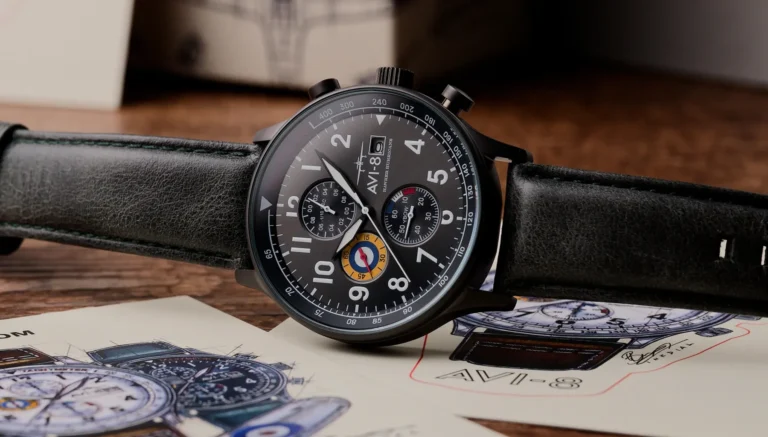
Aviator Watch
A watch specially developed for pilots. It is characterized by good readability, robustness and often a large crown.
A wristwatch is not just a timepiece, but an expression of style, precision and history.
B
Back system
A mechanism for regulating the period of oscillation of the balance wheel, which influences the accuracy of a mechanical watch. It enables fine adjustment of the rate.
Balance
A device used to check the balance of the balance wheel. It is used in watchmaking for precise adjustment.
Balance bridge
Holds the balance securely in the movement and ensures stability. It plays an important role in regulating the rate.
Balance spring system
The combination of the balance wheel and balance spring, which together form the oscillation system of a mechanical watch. It plays an integral role in the accuracy of a wristwatch.
Balance wheel
An oscillating component in a mechanical watch that determines the oscillation frequency and thus regulates the time. It is the “heart” of the watch.
Barrel
A cylindrical component that contains the mainspring. It stores the energy generated when the watch is wound.
Barrel bridge
Holds the barrel in position within the movement. It provides stability and protects the mechanism.
Bearing
Parts that support the rotating or sliding components of the movement. They reduce friction and contribute to the longevity of the watch.
Bearing jewels
Small gemstones, usually made of ruby, used in mechanical watches to minimize friction. They extend the service life of the moving parts.
Beryllium
A light and strong metal that is often used in the manufacture of balance springs. It is anti-magnetic and corrosion-resistant.
Beveling
Finishing technique in which the edges of movement components are beveled and polished. Only used on high-quality watches due to the high cost involved.
Bezel
The outer ring around the dial that frames the watch glass. In pilot’s watches, the bezel can usually be rotated to measure flight times.
Big Date
A large date display shown on two disks. It makes the date easier to read.
Bimetallic screw balance
A balance wheel made of two different metals to compensate for temperature differences. This keeps the watch more precise.
Blueing
A process in which metals are given a blue color by heating. It is often used on screws and hands to increase corrosion resistance.
Breguet hairspring
A special form of balance spring that enables a more even oscillation. It ensures the accuracy of the watch.
Bridge
A component that holds parts of the movement, such as the gear train or the balance wheel, in position. Bridges increase the stability of the movement.
Bridge movement
A movement that is stabilized by several bridges. It ensures greater robustness and precision of the mechanism.